open-memex
Persistent memory for AI coding agents — on your machine, in plain Markdown, shared by every tool you code with.
GitHub repository · npm package · Glama score · Documentation · Releases

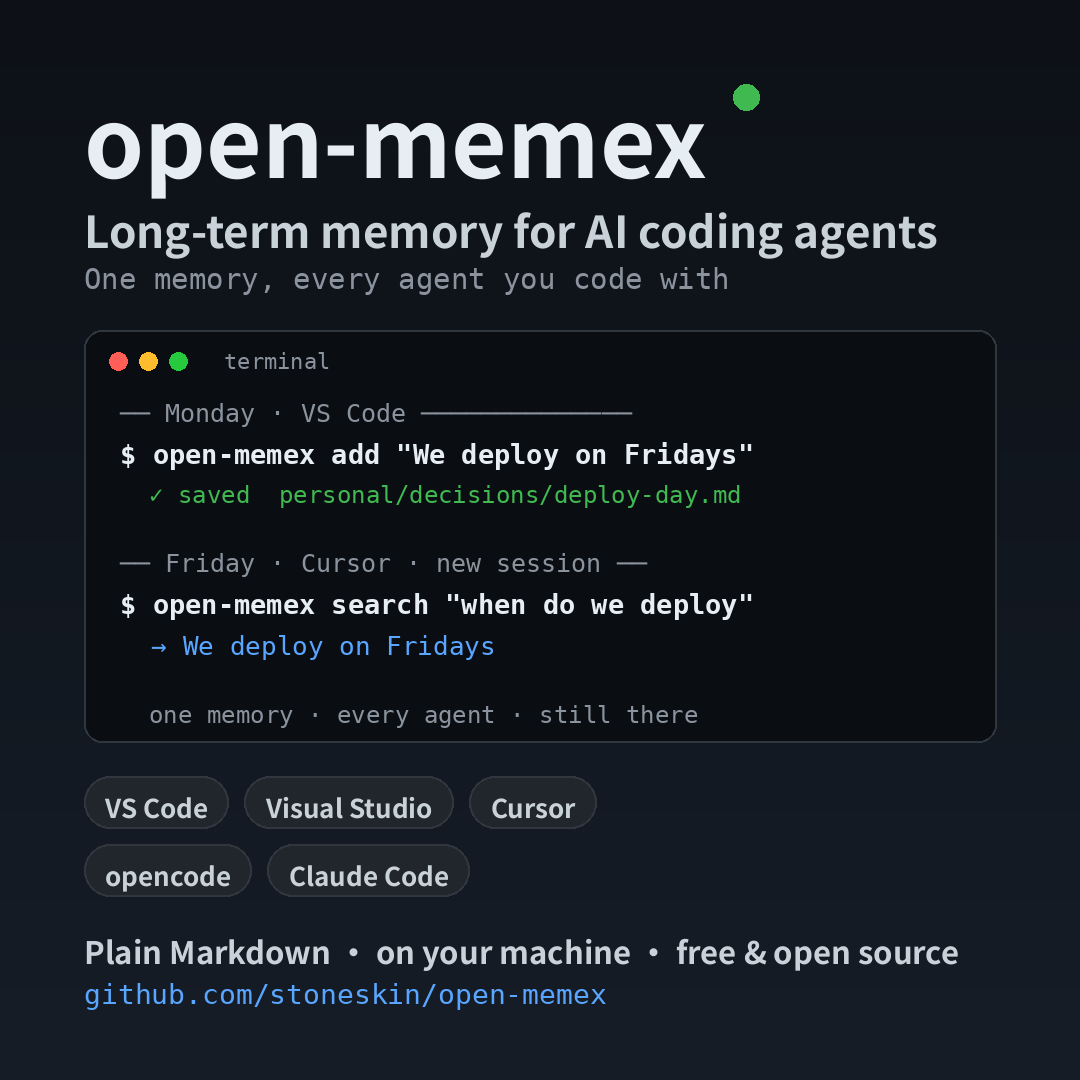
Every AI coding session starts from zero: you re-explain the project, the agent rediscovers the same gotchas, and yesterday’s decisions vanish when the chat ends. open-memex gives your agents a memory that survives the session.
Say “remember: we deploy on Fridays” once. Next week, Copilot, Cursor, opencode, or Claude Code already knows — because they read and write the same local memory on your machine.
Get started in about a minute
Requirements: Node.js 22.14 or newer.
npm install -g open-memex
open-memex init
open-memex add "We deploy only before noon on Fridays" --type decision
Then ask your agent what it remembers. open-memex init auto-detects supported editors and wires up the integration for you.
Why open-memex?
- One memory, every agent. Developers rarely use only one AI tool. open-memex avoids separate memory silos by giving the tools on one machine a shared local store.
- Your files, your rules. Memories are plain Markdown files you can read, edit, search with normal tools, back up, or delete. A rebuildable SQLite FTS5 index makes them fast to retrieve.
- Local-first by design. No account, no cloud service, no telemetry. Personal memories never leave the machine unless you explicitly export or share something.
- Human review stays in the loop. Capture can be automatic or agent-assisted, but memory remains inspectable and correctable — hide it, supersede it, forget it, or review it before it is shared.
- Teams share through Git. Project knowledge can move from a personal draft to a reviewed project memory through the normal branch / pull-request workflow instead of a separate sync service.
How it works
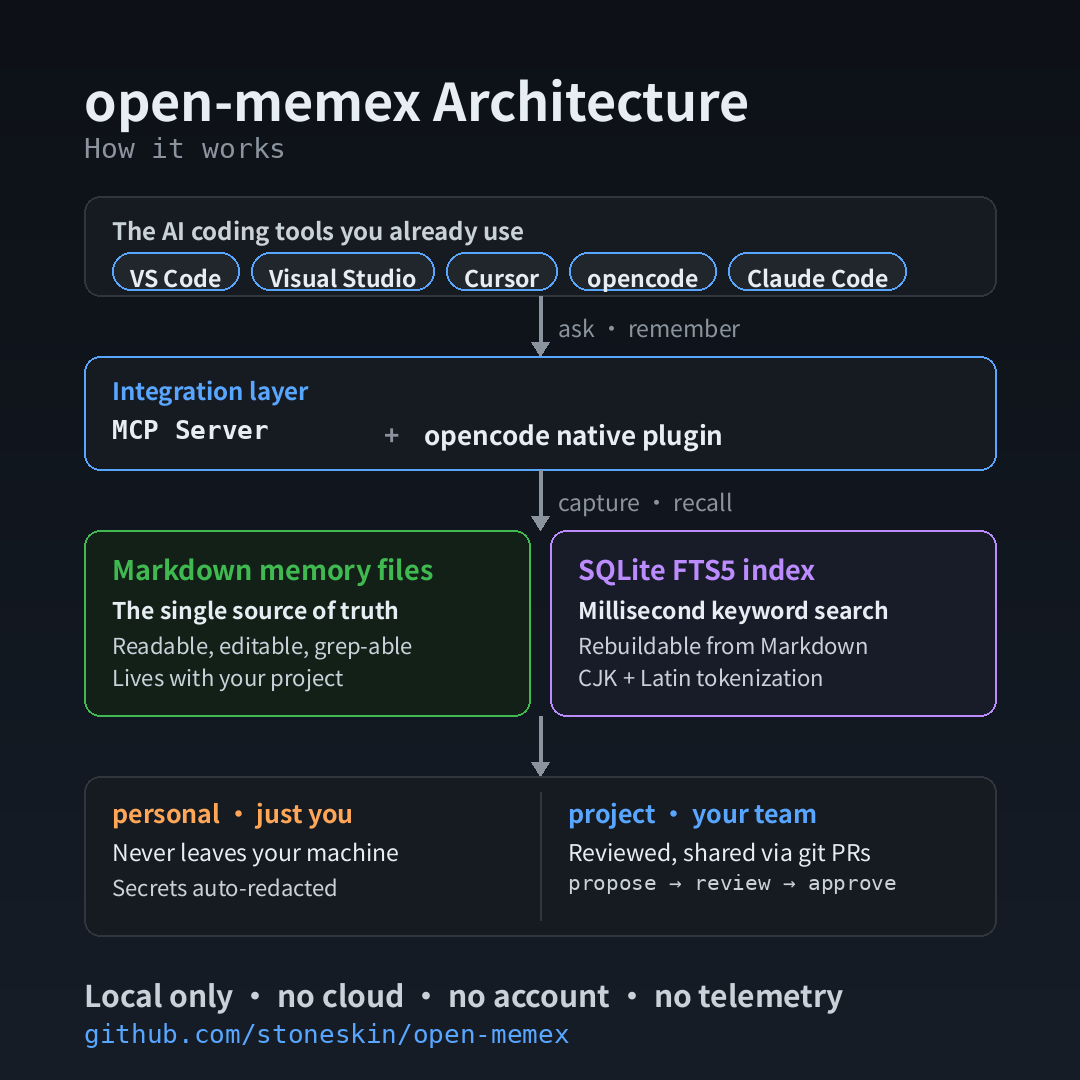
- Capture — Save a decision, constraint, preference, lesson, or project fact through your agent, the CLI, or supported keyword triggers.
- Store — open-memex writes a structured Markdown memory and updates its local SQLite keyword index.
- Recall — In a later session, the agent can search the memory or receive relevant context automatically where the host supports first-turn injection.
- Review and share — Personal memories stay local. Project memories can be proposed, reviewed, approved, and published through Git.
Works with the tools you already use
open-memex provides a native opencode plugin and a standard MCP server used by tools including:
- VS Code Copilot
- Cursor
- Claude Code
- Visual Studio
- opencode
The same memory layer is underneath each integration, so a constraint captured in one editor can be respected in another.
Built for knowledge that should outlive a chat
Use open-memex for the long tail of engineering knowledge that rarely belongs in a formal design document:
- deployment rules and environment quirks
- API limits and integration constraints
- architecture decisions and the reasons behind them
- recurring failure modes and their fixes
- team conventions and review expectations
- your own working preferences
Privacy and safety
- Memories live locally; there is no open-memex cloud.
- Common API keys and tokens are masked before a memory is saved.
- Text wrapped in
<private>…</private>is stripped before saving. personalscope never syncs. Project sharing is explicit.- Run
open-memex doctorto check the installation, scope resolution, storage, editor wiring, and SQLite driver.
Project status
open-memex is open source under the Apache-2.0 license. The current stable release is 0.7.1. Start with the GitHub README for the full guide, or open a question in GitHub Discussions.
Created by Mr Sun.