32. Clones can copy the gameplay, not why you made it this way (2026-10-26)
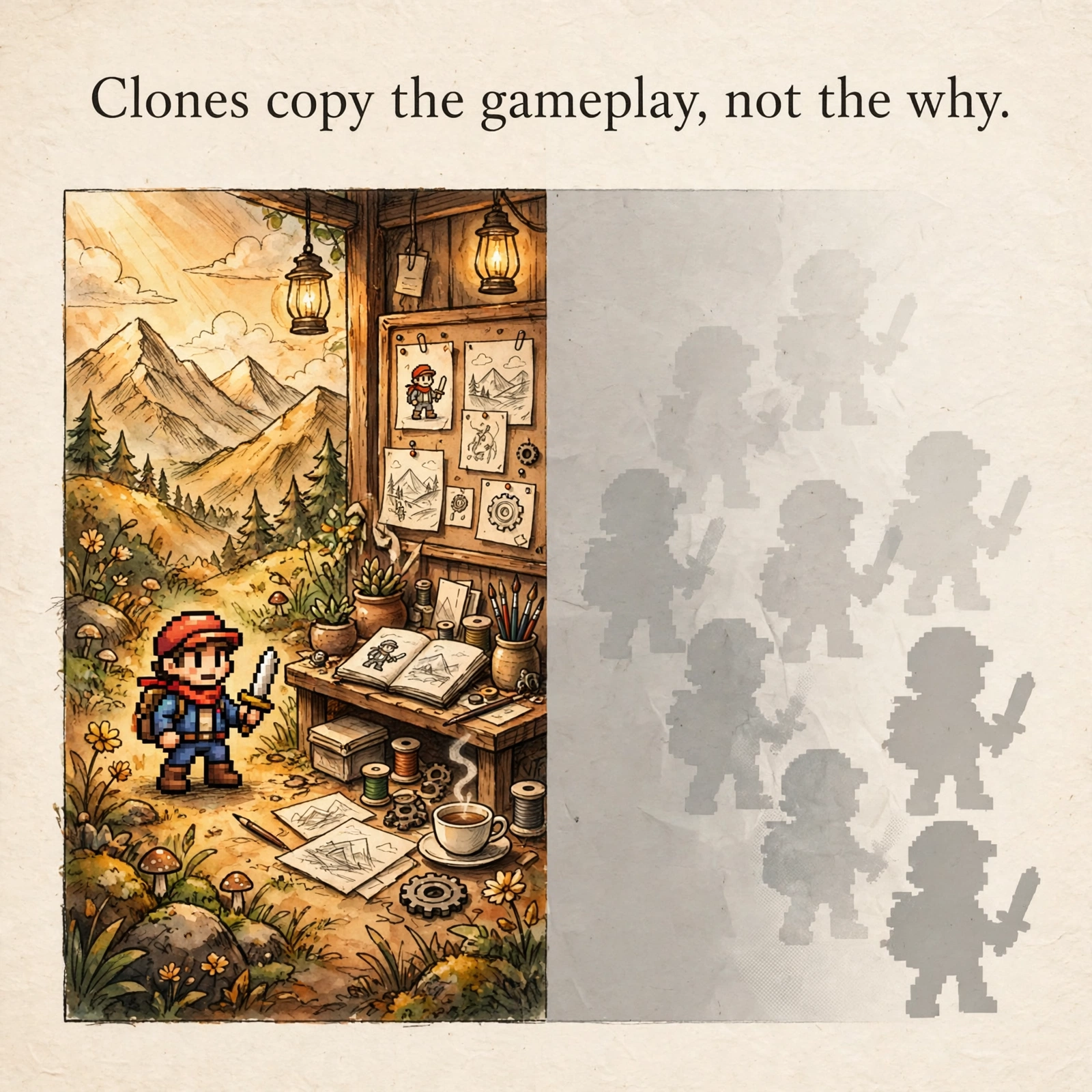
Reading the news from Steam Next Fest: October 2026 Edition, my first reaction was a chill too: more than seven thousand demos, a game not yet released, its gameplay video goes viral, and within days a dozen imitations appear on Roblox, reskinned and ready to take money. AI has compressed the time from “understand and replicate” from weeks to days, and it feels as if indie makers are robbed the moment they show their heads.
But after checking the cases one by one, I found I had aimed at the wrong enemy. What gets called “being copied” is actually three different things mixed together.
The first is a mechanic cleanly rewritten. That cannot be stopped, and never could be, since games began; AI only makes it faster. Once an idea is public, it is no longer your private property; what you keep is only the version you made of it.
The second is assets and code lifted verbatim. That one can be stopped, and should be stopped in advance: do not pack unfinished work into a public demo, do not put critical logic entirely on the client, and keep creation records with timestamps. When something is lifted verbatim, platform complaints work; what you fear most is opening the door yourself.
The third is the easiest to overlook, and the most fatal: not dying by copying, but dying by not being seen. With more than seven thousand demos laid out together, players cannot flip through them all, and a good game can sink. Copying only accelerates competition; discovery itself has become the new bottleneck.
So the moat was never in that line of code. Code is the cheapest part of a game, and AI, however fast, only gets faster at the cheap part. What is truly expensive, imitations cannot take: the feel of a jump honed over hundreds of playtests, a difficulty curve revised again and again, why a whole art style is this color, why this character stops here, why this story closes at this point — these “whys” are taste.
For people who make art and games, that sentence is even more direct: a style can be learned, but a whole set of choices cannot be copied in one pass. AI can draw a picture that looks like yours; it cannot draw a whole world and say why it is this way. It can copy a mechanic; it cannot copy why you added this layer of content, this stretch of narrative, this update after that mechanic.
AI has made production cheaper, and that has made the “why” more expensive instead. The era when one good idea plus one demo could break out is indeed ending. What becomes valuable next is the ability to carry an idea all the way through, to make it thick and continuous, and the trust that makes people willing to follow you. Imitations can manage “looks like it”; they cannot manage “keeps going”.
This is not the death of creativity; it is creativity changing places: from “coming up with it” to “making it, keeping at it, and earning trust”. For people who truly make things, that is actually good news, because the latter cannot be copied.
Source: Steam Next Fest Has Become A Massive Disaster And A Grim Look At The Future