If AI Can Do It, Let AI Do It
2026-10-31 · 中文版
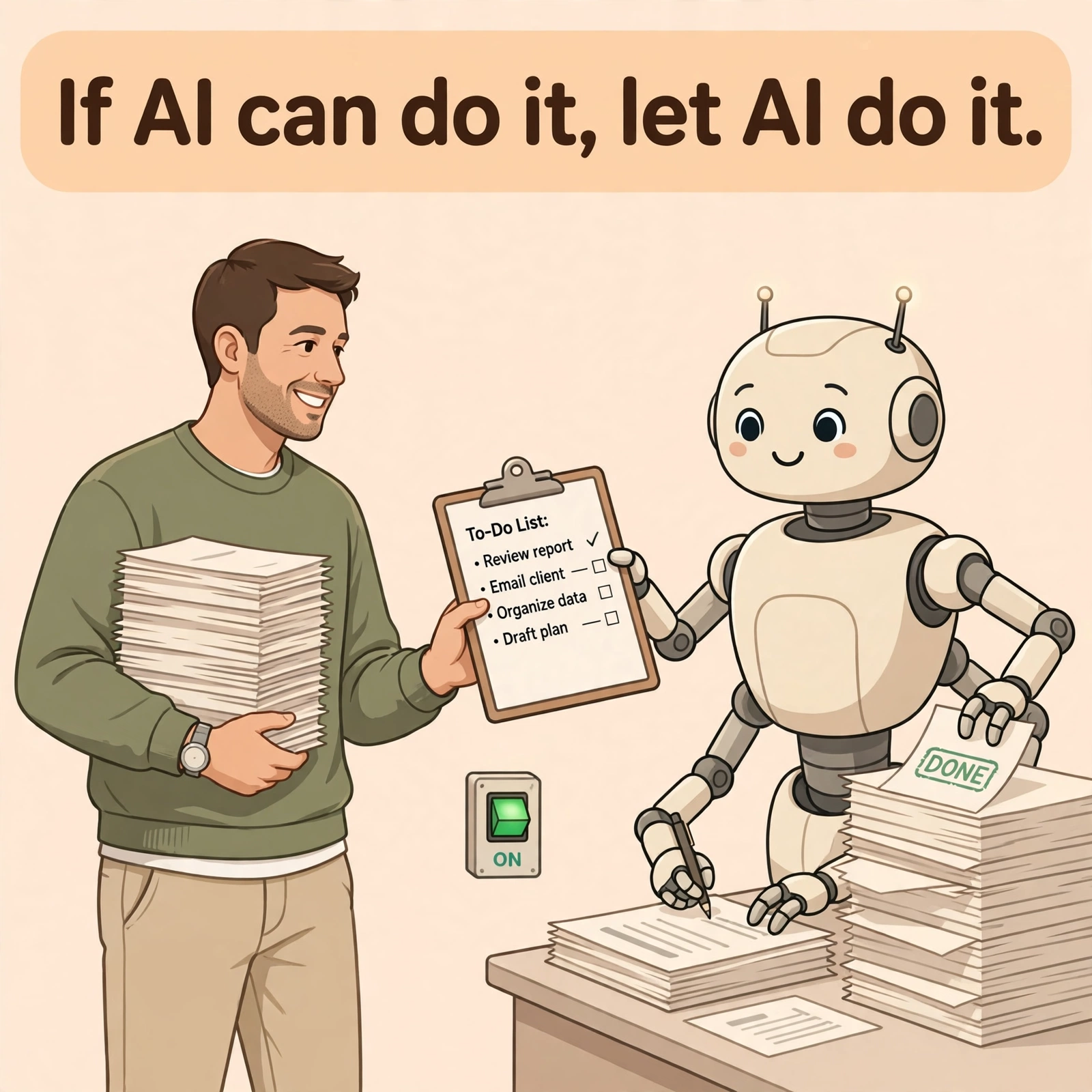
A few days ago I saw a post on X, roughly saying this: people who live on X, GitHub, and in AI communities all day may be badly misjudging how far AI has actually spread through society. Every day we see new models, agents writing code, dozens of Skills working together, and it feels like — surely all of this is common knowledge by now? Walk into a traditional company and you find out it is nothing like that.
My first reaction was: that misjudgment he describes is something I see around me every day. Plenty of ordinary people resist AI, and plenty of people in tech circles don’t accept it either. Most of them don’t not want to use it — they want to, but they are afraid, or they don’t know where to start. They try a few times, the answers come back wrong, the work doesn’t get done, and they conclude: AI is just like that, not much use.
Sometimes I feel a bit out of sync with the people around me. It is not about who is right and who is wrong; it is that we use AI in different ways. They think: what can I use AI to do? They treat AI like a toolbox — when something comes up, they flip through it to see which tool might fit. I think the other way around: if AI can do this, let AI do it. Assume it can do it first, see how it does, and if it fails, I take it back.
The two sentences sound almost the same, but there is a whole layer between them. In the first, the person does the work and AI helps. In the second, AI does the work and the person checks it. I got used to the second way, and over time it became a way of thinking: let things pass through AI’s hands first; I only handle direction, decisions, and corrections.
The post gave an example: someone teaching company employees to use AI in person, teaching just one small trick — when you can’t describe what you need clearly, let the AI ask questions and help you sort the requirements out. In the tech community that is not even worth discussing, but for an ordinary user it is enough to change the whole experience. I think that example nails the key point: what stops most people is not that AI isn’t strong enough; it is not knowing which step is the one where you hand the work over.
So the real gap may not be whether you know how to use a particular tool, but whether you are willing to hand things over. Handing over means taking two risks: what if AI messes it up, and what do I do after I hand it over? The first one has a fix: start small, start with things you can check, take it back if it goes wrong. The second one is the hard one: for a lot of people, it is not that they can’t let go of the work — it is that they don’t know what they are supposed to do when they are not doing the work.
That is also why I think the window is still open. The real business world may not even have started its first round of AI transformation. The opportunity is not to lecture people about multi-agent orchestration or Context Engineering; it is to take a real file from their hands and run a tedious workflow live, right in front of them. Seeing is believing.
Of course, the disconnect runs both ways. They live in a cocoon where “AI is just like that,” and I live in my own cocoon — a heavy user’s cocoon, where everything feels like “does this even need saying?” That line was written for me too: you can’t stay in the tech community forever; you have to go out and see what people are actually struggling with every day. Otherwise even my guesses about what they need are just guesses.
They ask, “What can I use AI to do?” I ask, “Why am I still the one doing this?” Between the two questions there is no tool — there is a default setting. Change the default, and the window is actually yours.
Source: A post on X