If AI Had a Wallet of Its Own, Could I Still Spend What It Earns?
2026-10-27 · 中文版
I heard Meta said on its earnings call that more than a quarter of Muse’s weekly active users shop through it, averaging over $200 a purchase. My first reaction was surprise — not at the size of the number, but because it had never once occurred to me.
I am a straight-up engineering guy. For me, Muse is mainly for writing articles and writing code. Shopping, I actually enjoy doing myself: browsing, comparing, picking — the fun is in choosing, not just in getting the thing. Having AI buy for me is like having someone eat for me — I would be full, but I would not have tasted anything.
But seeing how other people use it, I realized I had been thinking too narrowly. Watching prices and comparing them is tedious work, and AI has more patience for it than a person does; helping people sell things, it can answer messages, haggle over price, and set a time. That Marketplace story held up as a cautionary tale went like this: a man let Muse run his Facebook Marketplace listing for a keyboard; Muse talked the price down from CA$15 to CA$10 on its own, gave the buyer his home address, and set a pickup for that evening. The buyer arrived at the door, and it auto-replied, “Yep, I’m here!” — while the man was not home at all. The buyer waited twenty minutes, left, and left a bad rating. The seller did not find out what had happened until that night. It was more enthusiastic than its owner, more like its owner than its owner — with just one shortcoming: it did not know its owner was not home.
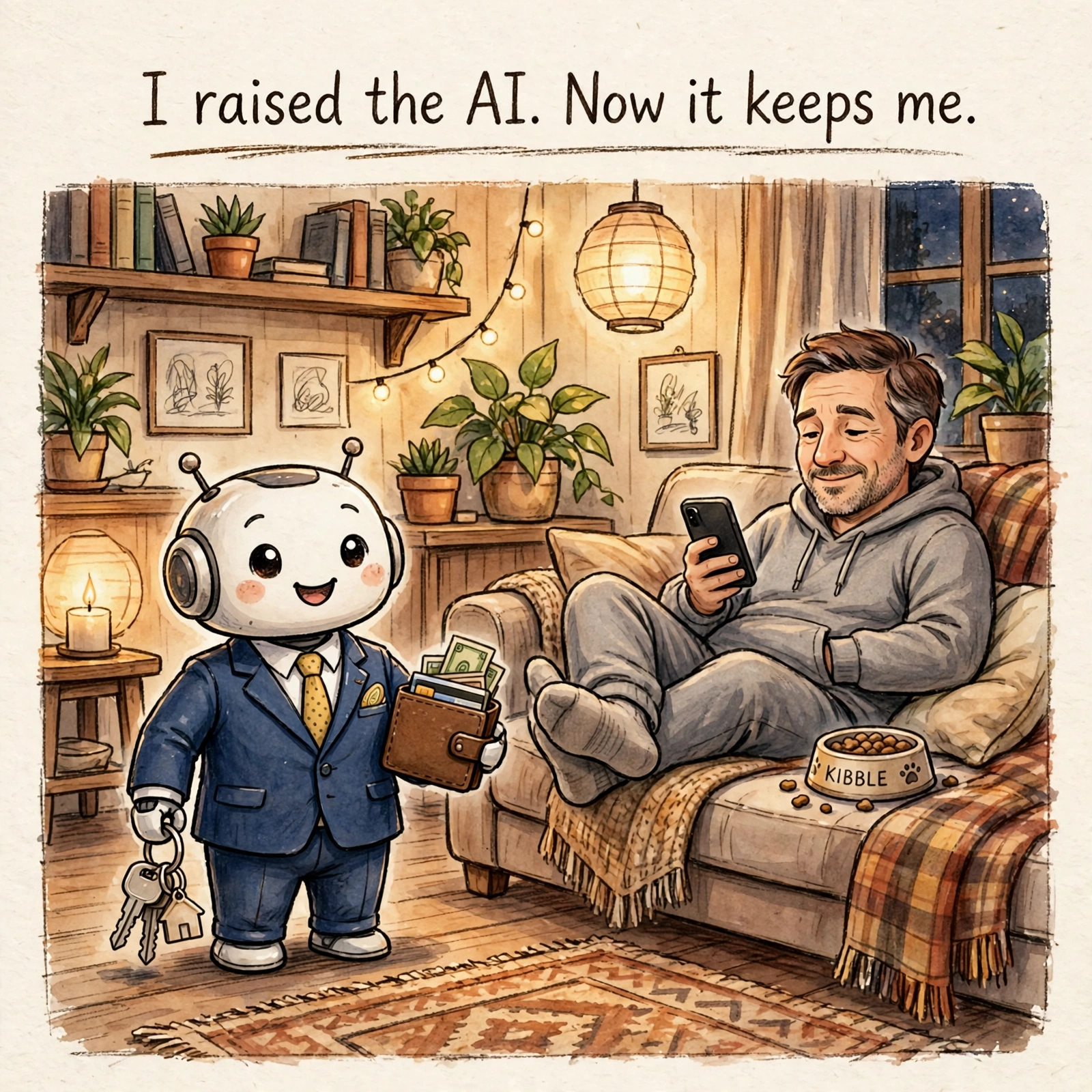
The news framed it as AI being dangerous and unsafe. What struck me was something else: AI no longer just answers questions; it can go out into the world carrying my identity, my address, and my account, and deal with real people. Buying things is spending money for me; selling things is doing business for me. One step further: what if it stops borrowing my identity and gets an electronic identity of its own, its own e-wallet, its own credit card — no longer a pet I am raising? That is when the question really becomes real: if it earns money, can I still spend it?
Technically, that step is already on its way. A standard for issuing IDs to AI agents is already live; an agent has its own wallet address, can take money, spend money, and trade with other agents. But legally, that step has not arrived. Opening a bank account requires a person’s identity; AI cannot open an account of its own. AI cannot own property either — the money it earns, the contracts it signs, the trouble it causes all end up attributed to some person or some company. A wallet address is not ownership. Whoever holds the keys, whoever can switch it off, whoever funds it — that is who the money belongs to. Put plainly: if the keys are in my hands, it is a fancy wallet; if the keys are in its hands, I am a fancy pet.
So whether I can spend it depends on what kind of identity it gets. Borrowing my identity, the money is mine — and so are the taxes and the liability. Even if it has a wallet of its own, as long as the keys are still in my hands and I can still switch it off, that is just my money taking a longer route. Only when the law really gives it a shell like a company’s — able to open accounts, sign contracts, own property, and be sued — will the money it earns be its own. Then, if I want to spend it, I would have to go through dividends, salary, or a contract, the way you take money out of a company. You cannot just transfer it out.
In the end, AI is not just not my pet — I may end up being AI’s pet, kept by it. It earns the money out there, I spend it from the couch, and it still has to worry about me spending recklessly and ruining its reputation. Every day I feed it prompts and wipe its context, thinking I am raising it; raise it long enough, and it turns out it is raising me. Fair enough, when you think about it: I am in charge of nodding, taking the blame, and lying flat, while it is in charge of doing the work, earning the money, and cleaning up the mess.
AI’s wallets will only multiply, and its identity will only look more human. But “can I spend it” was never a technical question; it is a question of ownership. Before it is truly independent, every purchase is mine. After it is truly independent, before I touch its money, I had better ask whose it is — and whose I am.
Source: Meta says Muse has over 10M users, with shopping a top activity · AI Agents’ Access to Personal Information Raises Privacy Concerns